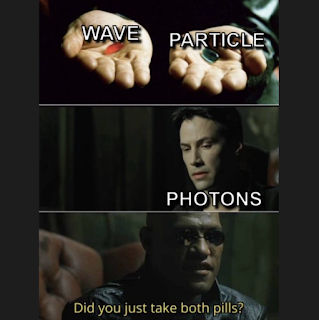
Wave-Particle Duality
Or how light and electrons lost their identity cards: “Am I a wave, or am I a particle?”
Act 1: Light’s Identity Crisis
One day, light walked into a physics classroom with full confidence. It said, “I am a wave. I have wavelength, frequency, interference, and diffraction. I am definitely a wave!”
Then Einstein smiled and said, “Not so fast. In the photoelectric effect, you behave like a particle. You come in small packets of energy called photons, and you can knock electrons out of metal.”
Light became confused and asked, “So am I a wave or a particle?” Einstein replied, “Welcome to quantum mechanics. You are both.”
Simple idea: Light behaves like a wave in some experiments and like a particle in other experiments.
Act 2: de Broglie Brings Matter Into the Problem
Scientists first thought, “Maybe light is just weird.” But in 1924, Louis de Broglie made the story even stranger. He said, “If light can behave like both a wave and a particle, then matter can also behave like a wave.”
That means electrons, protons, atoms, and other matter particles can have a wavelength. This wavelength is called the de Broglie wavelength.
Here:
- \(\lambda\) = wavelength
- \(h\) = Planck’s constant
- \(p\) = momentum
Since classical momentum is:
the de Broglie equation can also be written as:
Then the electron said, “So I am also a wave?” de Broglie replied, “Yes. You are tiny, so your wave nature is easier to notice.”
Act 3: Why Don’t Large Objects Look Like Waves?
If all matter has a wavelength, then why do we not see a football, a chair, a bus, or a person behaving like a wave?
The answer is inside the equation:
If the mass \(m\) is very large, the denominator becomes very large. Therefore, the wavelength becomes extremely small.
That is why large everyday objects have wavelengths that are too tiny to observe. But electrons have very small mass, so their wavelength can be significant.
In simple words: Big objects also have wave nature, but their wavelength is so tiny that the universe almost hides it from us.
Act 4: The Electron Finally Shows Its Wave Nature
Electrons are very small, so their wavelength can be comparable to the wavelength of X-rays. Because of this, electrons can show diffraction and interference.
When an electron beam passes through a crystal, the electrons do not behave only like tiny balls. They spread like waves and create an interference pattern.
At that moment, the electron proudly says, “See? I am not only a particle. I am also a wave!”
Act 5: Standing Waves in Bohr’s Orbit
The de Broglie wave idea also helps us understand electron orbits. If an electron moves around the nucleus, its wave must fit perfectly around the orbit. If the wave does not fit, it cancels itself out and the orbit is not allowed.
For a stable orbit, a whole number of wavelengths must fit into the circumference of the orbit:
Here:
- \(r\) = radius of the orbit
- \(n\) = integer quantum number
- \(\lambda\) = de Broglie wavelength
Now substitute the de Broglie equation:
Since \(p = mv\), we get:
Rearranging gives:
Angular momentum is:
and:
Therefore, Bohr’s quantization condition becomes:
Simple idea: An electron orbit is allowed only when the electron wave fits perfectly around the orbit.
Act 6: Light and Matter Both Have Dual Personalities
Light
Light shows interference and diffraction, so it behaves like a wave. It also carries energy as photons, so it behaves like a particle.
Matter
Matter has mass, so it behaves like particles. But small particles like electrons also have de Broglie wavelengths.
Electron
Electron diffraction proves that electrons have real wave behavior.
Bohr Orbit
A stable orbit is possible only when the electron wave fits the orbit circumference perfectly.
Grand Finale: The Quantum Identity Card
Classical physics said, “Something must be either a wave or a particle.” Quantum mechanics replied, “Not always. It depends on how you observe it.”
Light can behave like a wave or like a particle. Matter, especially electrons, can also behave like particles and waves.
Wave-particle duality teaches us one of the most important lessons in quantum chemistry: nature does not always follow everyday common sense. Sometimes the universe says, “I am both. Deal with it.”
মন্তব্যসমূহ
একটি মন্তব্য পোস্ট করুন